 GOAT TATTOO
Foo Dog Tattoo Meaning: Shishi, Komainu and Vietnam's Nghê
Published October 21, 2026
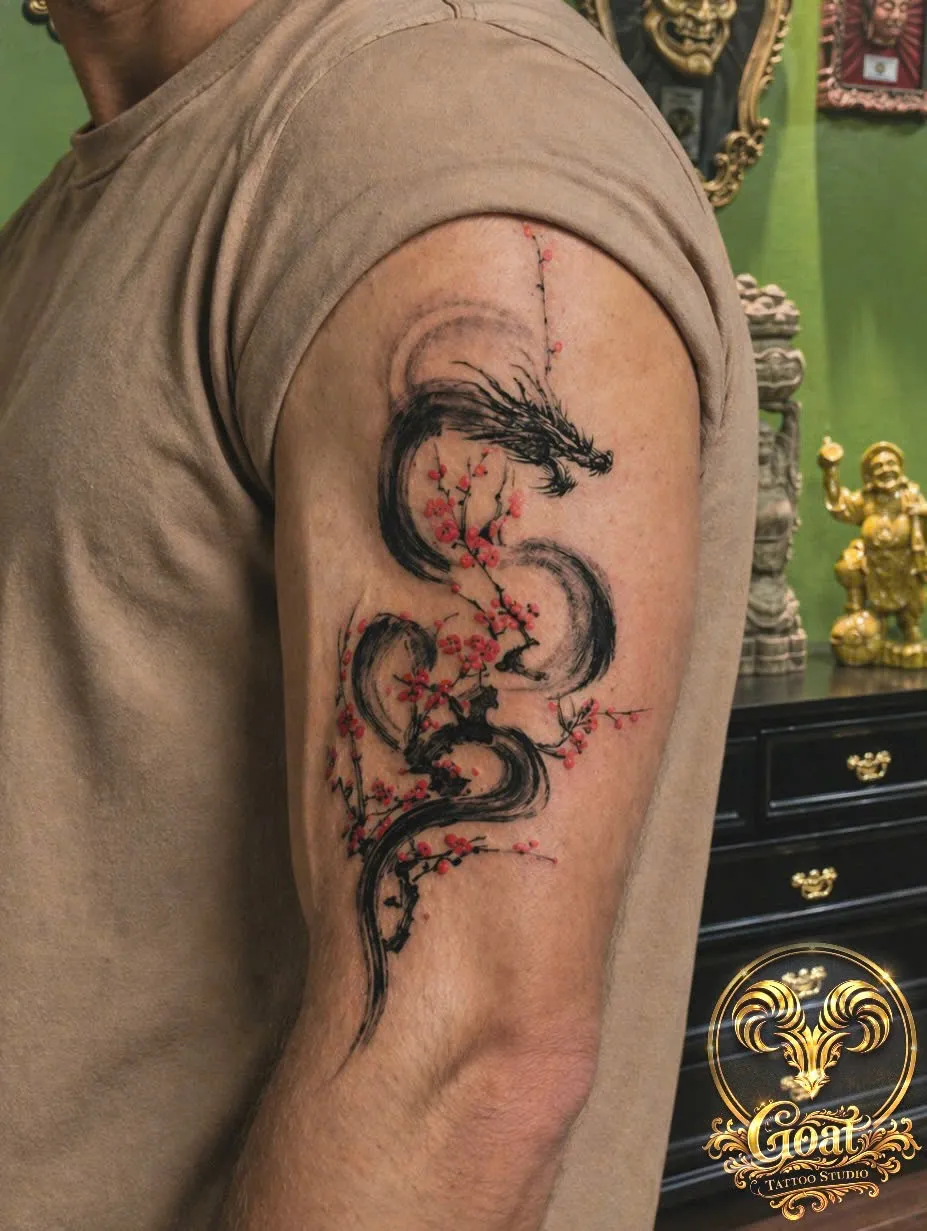
Short answer: a “foo dog” is really a guardian lion. In China, Japan, Korea and Vietnam, these creatures stand in pairs at gates, temples and shrines to keep evil out. As a tattoo they mean protection, guarding your home and family, and courage. In a pair they also stand for balance: male and female, open and closed, yin and yang. In Japanese tattooing, a lion with peonies is a classic combination: the king of beasts with the king of flowers. Vietnam has its own guardian creature, the nghê, which looks more like a dog.
You’ll see these guardians at almost every temple in East Asia, and they’re a popular subject for sleeves, calves and matching pairs. Here’s what each tradition adds.
Lions, not dogs
“Foo dog” is a Western nickname. Where “foo” comes from isn’t certain. It’s often linked to the Chinese words for Buddha (fó) or good fortune (fú). The creatures are lions, even though lions never lived in China or Japan. Artists who had only heard of lions made them look curly-maned and dog-like, and that look stuck.
China: guardian lions (shishi)
Stone guardian lions have flanked the entrances of palaces, temples, government buildings and tombs in China for many centuries. They come in pairs:
- The male rests a paw on a ball, often read as authority over the world.
- The female rests a paw on a cub, protecting the next generation and the household.
Our lion tattoo guide compares this guardian role with lion symbolism elsewhere.
Japan: komainu and karajishi
- Komainu guard Shinto shrines and Buddhist temples. The name is usually read as “Korean dogs”, after the route the image took into Japan. In many pairs one has an open mouth and the other a closed mouth. This is the “a-un” pair: the first and last sounds of the Sanskrit alphabet, a beginning and an end, like alpha and omega. In some older pairs, one also has a horn.
- Karajishi, the “Chinese lion”, is the fierce, curly-maned lion of Japanese art and irezumi. Its classic partner is the botan (peony). In this pairing the lion is the king of beasts and the peony the king of flowers. Our flower meanings guide covers the peony.
Japanese designs usually add swirling manes, wind bars, clouds or waterfalls around the lion.
Vietnam: the nghê
Vietnam has its own guardian creature, the nghê. It’s often described as a native cousin of the Chinese lion, smaller and more dog-like, with a curly mane and a lively, sometimes playful expression. You’ll find nghê guarding temples, pagodas, communal houses (đình) and tombs across the country, in stone, wood and ceramics. For a tattoo with a real Vietnamese story, a nghê is a fresh alternative to the familiar Chinese or Japanese lion.
Lions also have a place in Vietnamese festivals. During Tết and the Mid-Autumn Festival, lion dance (múa lân) troupes perform in the streets, and in Hanoi’s Old Quarter you can see colorful lion heads for sale before Mid-Autumn. Our history of tattooing in Vietnam and Vietnam-inspired tattoo ideas have more local symbols.
What a foo dog tattoo can mean
- Protection: a guardian that keeps bad luck and harm away from you.
- Family and home: the pair as protectors of a household, popular for parents and couples.
- Balance: two different natures that complete each other.
- Courage and loyalty: a fierce guardian that never leaves its post.
Design ideas
- Pairs: one guardian on each forearm, calf or shoulder; open mouth and closed mouth; one with the ball, one with the cub.
- With peonies: the classic Japanese combination, great for sleeves and back pieces.
- With a dragon or an oni: guardians facing danger. See our dragon guide and oni mask guide.
- Color or black and grey: color brings out the manes and peonies, while black and grey gives a stone-statue feel.
Size and placement
The curly mane, face and paws need space. A single guardian works on the upper arm, thigh, calf or shoulder blade. A pair works on matching limbs or across the chest. On a sleeve or back piece it can be the main subject, with peonies and wind around it. For a smaller piece, a guardian’s head alone holds up better than a full body.
At GOAT Tattoo Studio
At your consultation we can help you choose between a Chinese lion, a Japanese komainu or karajishi and a Vietnamese nghê, and plan a pair that works on your body. Our Japanese gallery shows Japanese-style work from the studio, and our traditional Vietnamese tattoo page covers Vietnamese motifs.
Planning a Japanese tattoo in Hanoi? Our Japanese tattoo page has prices, the artists who do this style and recent work.
Related Guides
- Lion Tattoo Meaning: Guardian vs. King
- Japanese Tattoo Motifs and What They Actually Mean
- Oni Mask Tattoo Meaning: Demon, Protector or Both?
- Samurai Tattoo Meaning: Bushido, Ronin and Cherry Blossoms
- Dragon Tattoo Meaning: East vs. West
- Flower Tattoo Meanings Explained
- The Real History of Tattooing in Vietnam
- Tattoo Ideas Actually Inspired by Vietnam
- Peony Tattoo Meaning: King of Flowers in China, Japan and Vietnam
- Raijin and Fujin Tattoo Meaning: Japan's Thunder and Wind Gods
- Dog Tattoo Meaning: Loyalty, Pet Memorials and Guardian Dogs
Ready to book your tattoo in Hanoi?
Send us your idea and preferred dates — we'll reply with a clear quote before you sit in the chair.
Book Now