 GOAT TATTOO
Samurai Tattoo Meaning: Bushido, Ronin and Cherry Blossoms
Published October 21, 2026
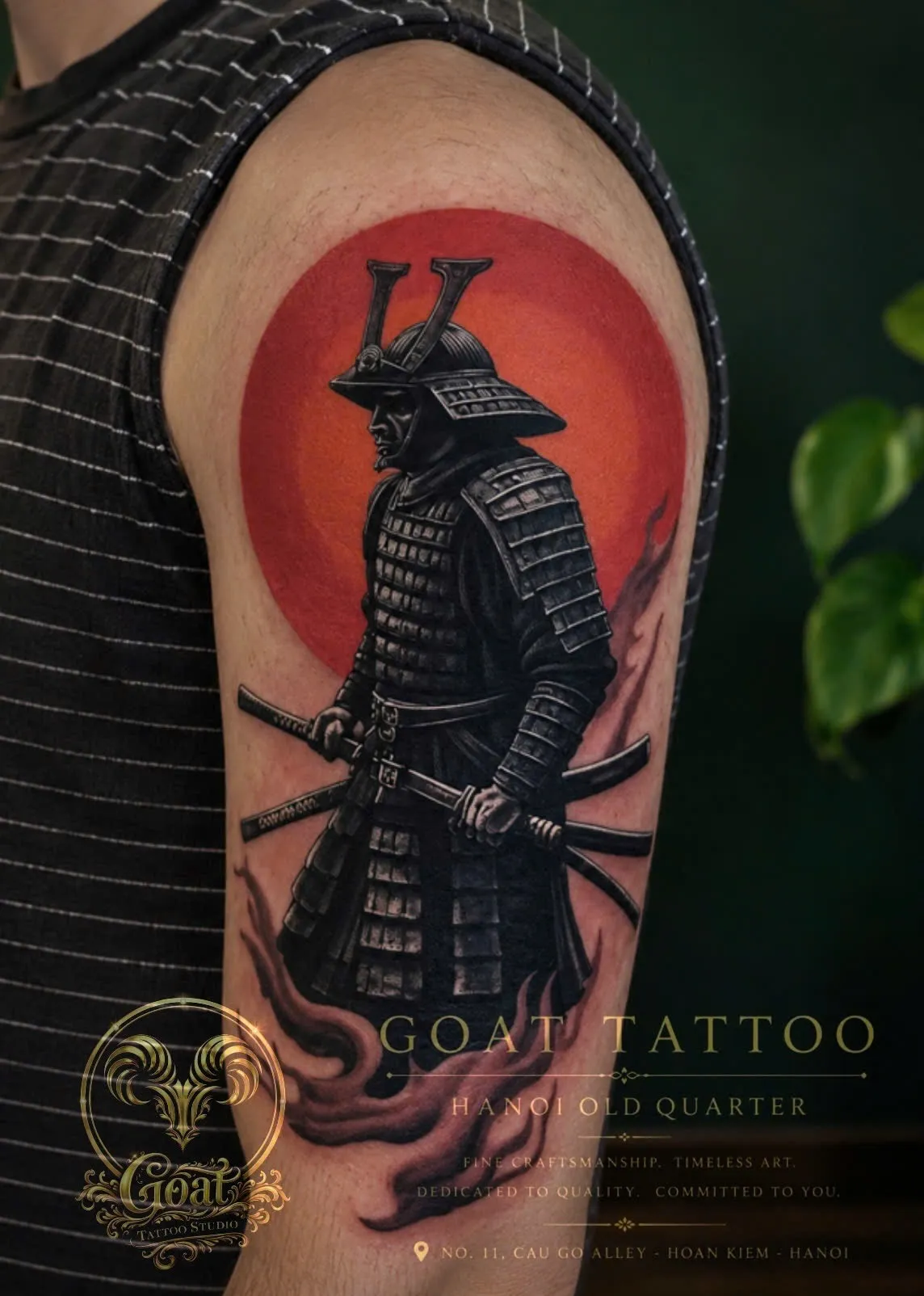
Short answer: a samurai tattoo usually stands for discipline, loyalty, courage and facing death without fear, the ideals linked to bushido, the “way of the warrior”. A ronin, a samurai without a master, shifts the meaning towards walking your own path, or towards loyalty that outlives everything else, as in the story of the 47 ronin. Cherry blossoms next to a samurai add the idea that life is short and should be lived with honor. One honest detail: real samurai almost never had tattoos. Samurai imagery entered tattooing through Edo-period woodblock prints and theater.
The samurai is one of the most requested Japanese tattoo subjects, often as a full back piece or a sleeve. Here’s what the figure means and which details change the story.
Who the samurai were
The samurai were Japan’s hereditary warrior class. They rose to power in the late 12th century, when the first shogunate (military government) was set up in Kamakura. They then ruled the country for almost 700 years. In the long peace of the Edo period (1603–1868) many of them became administrators rather than fighters. The class was abolished after the Meiji Restoration, and in 1876 wearing swords in public was banned.
Bushido: the code behind the image
Bushido is usually summed up as loyalty to one’s lord, courage, self-discipline, honesty and a calm acceptance of death. Historians point out that the neat, idealized version many people know was largely shaped later. A major influence was Nitobe Inazō’s book Bushido: The Soul of Japan, written in English in 1900. For a tattoo, that doesn’t make the ideals less meaningful. Just know that “bushido” is a set of values, not one ancient rulebook.
Ronin and the 47 ronin
A ronin was a samurai whose lord had died or who had lost his position. He had no master and often no income. In tattoos the ronin carries two quite different meanings:
- Independence: someone who walks alone, starts again or answers only to their own code.
- Loyalty beyond everything: in the Akō incident of 1701–1703, 47 ronin avenged their lord and then accepted death for it. Retold endlessly in theater as Chūshingura, it became Japan’s most famous story of loyalty.
A ronin is often shown in a wide straw hat, sometimes alone in rain or wind.
Common elements and what they add
- Cherry blossoms (sakura): beauty that falls at its peak, the classic image of a warrior’s short life. See our Japanese motifs guide.
- Armor, helmet (kabuto) and face mask (menpō): a masked or helmeted samurai feels more anonymous and fierce. A bare face makes it more personal.
- Katana: drawn for action, sheathed for control and restraint.
- A samurai fighting a dragon, a tiger or an oni: a struggle with something bigger than yourself, whether fear, illness or your own temper. See our oni mask guide.
- A hannya mask with a samurai: a warrior facing obsession or jealousy. The hannya guide explains the mask.
- A skull samurai: a memento mori, remembering death to live better. See our skull tattoo guide.
- A wolf beside a samurai: loyalty and the lone path together. See our wolf guide.
- A red sun or a crescent moon behind the figure: mainly composition and contrast, but often read as day and night, or life and death.
Why real samurai rarely had tattoos
In the Edo period, the tattoo culture that became irezumi belonged to commoners: firefighters, laborers, craftsmen and merchants. Samurai were expected to keep their bodies unmarked. Warriors came into tattooing through musha-e (warrior prints) by artists such as Utagawa Kuniyoshi, and through kabuki heroes. So a samurai tattoo is a tribute to an image and its ideals, not a copy of what samurai themselves wore. Our Vietnam vs. Japan guide covers how tattoos are seen in Japan today.
Kanji with a samurai
Words such as 武士道 (bushidō), 忠 (loyalty) or 誠 (sincerity, the character on the Shinsengumi’s banner) are often added. Have any kanji checked by a native reader before the session. Our kanji accuracy guide explains why.
Size and placement
A samurai has a lot of detail: armor plates, cords, a face and a sword. It works best large.
- Full back or back and buttocks: the classic Japanese format, with room for background clouds, wind and blossoms.
- Sleeve or half sleeve: the figure runs along the arm, with blossoms or waves filling the gaps.
- Upper arm, thigh or calf: good for a single figure or a samurai bust.
- Small pieces: a katana, a kabuto helmet or a mask alone holds up better at small size than a full figure.
At GOAT Tattoo Studio
Our Japanese gallery includes samurai work done at the studio, such as a color samurai with a red sun on the upper arm, a samurai-and-wolf back piece and a black and grey skeleton ronin. At your consultation we can talk through which version of the samurai’s story fits what you want to say, and how big it needs to be to keep the detail.
Planning a Japanese tattoo in Hanoi? Our Japanese tattoo page has prices, the artists who do this style and recent work.
Related Guides
- Japanese Tattoo Motifs and What They Actually Mean
- Oni Mask Tattoo Meaning: Demon, Protector or Both?
- Hannya Mask Tattoo Meaning: Rage vs. Sorrow
- Color & Japanese-Style Tattoos: What to Actually Look For
- Getting Kanji or Hanzi Tattooed: How to Actually Verify It's Correct
- Wolf Tattoo Meaning: Fenrir & the Lone Wolf
- Skull Tattoo Meaning Explained
- Vietnam or Japan: Where Should You Get Tattooed?
- Raijin and Fujin Tattoo Meaning: Japan's Thunder and Wind Gods
- Daruma Tattoo Meaning: One Eye, Two Eyes and Getting Back Up
- Cherry Blossom Tattoo Meaning: Sakura, Plum or Peach Blossom?
- Japanese Wave Tattoo Meaning: Hokusai's Great Wave and Irezumi Water
Ready to book your tattoo in Hanoi?
Send us your idea and preferred dates — we'll reply with a clear quote before you sit in the chair.
Book Now