 GOAT TATTOO
Cupid and Cherub Tattoo Meaning: Love, Arrows and Innocence
Published October 26, 2026
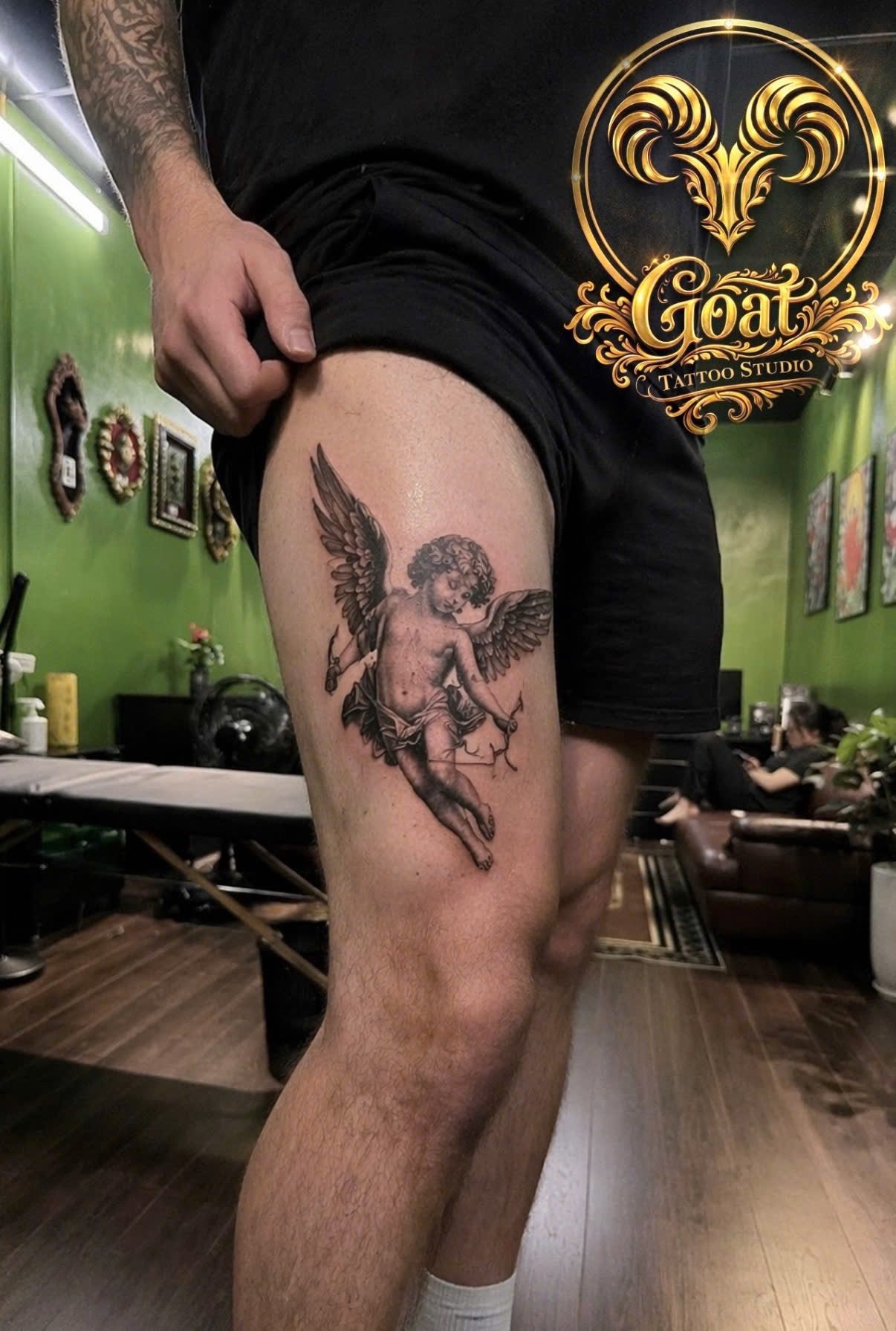
Short answer: a Cupid or cherub tattoo usually means love, romance and playful innocence. Cupid is the Roman name for Eros, the Greek god of desire, whose golden arrows make people fall in love. The chubby winged babies in Renaissance and Baroque art are technically called putti, but most people know them as cherubs, and they stand for innocence, joy and heavenly protection. A cherub is also a common memorial tattoo for a baby or child, while a Cupid drawing his bow is a classic tattoo for someone in love, or for someone who has been “struck” by love more than once.
Cupids and cherubs are some of the most recognisable figures in Western art. Here is where they come from, how they differ, and how to design one that looks like a classical painting or statue on your skin.
Love, desire and playfulness
Cupid is the face of falling in love: sudden, a little dangerous and impossible to control. That is why he carries a bow and arrows, because love strikes without warning. As a tattoo, Cupid can celebrate a relationship, a marriage or a wedding anniversary, or simply a belief in love. Because he is often shown as a mischievous child, he also brings a sense of humour: a Cupid with a broken bow or a missed arrow can be a funny tattoo about bad luck in love. Valentine’s Day cards have made him a symbol of romance around the world.
Eros and Cupid: the god behind the arrows
In Greek myth, Eros was the god of love and desire, usually called the son of Aphrodite. The Romans called him Cupid (from cupido, “desire”) and made him the son of Venus. In the Roman poet Ovid’s Metamorphoses, Cupid has two kinds of arrows: a sharp golden arrow that makes the person it hits fall in love, and a blunt lead arrow that makes them run from love. To punish Apollo, he shot Apollo with gold and the nymph Daphne with lead, so Apollo chased her until she turned into a laurel tree. In early Greek art Eros was a handsome winged young man; only later did he become the chubby child most people imagine. For the other gods of Olympus, see our Greek gods guide, and for the meaning of the arrow itself, see our arrow tattoo guide.
Cupid and Psyche
The Roman writer Apuleius told the story of Cupid and Psyche, a mortal woman so beautiful that Venus became jealous. Cupid fell in love with her, but visited her only in the dark and told her never to look at his face. When she lit a lamp to see him, he flew away, and she had to complete impossible tasks set by Venus to win him back. In the end she was made immortal and they married. Psyche means “soul” in Greek, so the story is often read as love and the soul finding each other after trust is broken and rebuilt. A Cupid and Psyche tattoo is a beautiful choice for couples who have been through hard times together.
Cherub, putto or Cupid?
These three words are often mixed up:
- Cherub (plural cherubim): in the Bible, cherubim are powerful heavenly guardians, not babies. They guard the way to the Garden of Eden with a flaming sword, and two golden cherubim spread their wings over the Ark of the Covenant.
- Putto (plural putti): the chubby, naked winged children of Renaissance and Baroque paintings and sculpture. They can be angels, Cupids or just decoration. The two bored-looking little angels at the bottom of Raphael’s Sistine Madonna (1512) are the most famous.
- Cupid: the god of love himself, usually with a bow and arrows, sometimes blindfolded because “love is blind”.
In everyday English, and in tattoo studios, a winged baby is simply called a cherub, so do not worry about the technical name. Just tell your artist whether you want a bow and arrows (Cupid), a halo or clouds (an angel) or neither. For wings on their own, see our angel wing guide.
Memorial and protection
Because cherubs look like small children with wings, many parents choose one to remember a baby or child who has died, sometimes with a name, a date or a ribbon. Others choose a cherub for their own children as a symbol of protection and innocence, or as a guardian angel watching over them. For memorial ideas and how to plan them, see our memorial portrait tattoo guide. In Christian homes, cherubs on statues and gravestones are also a sign of heaven and hope, so the tattoo can carry quiet religious meaning too.
Design and placement
- Style: black-and-grey realism is the classic choice, because it can copy the soft light of an old painting or the smooth surface of a marble statue. Fine line suits a small, simple Cupid, and neo-traditional colour suits a bold Valentine’s design.
- Pose: a flying cherub means joy and freedom, a sleeping or resting one means peace, a Cupid aiming his bow means desire and pursuit, and two cherubs together can stand for a couple or for siblings.
- Combinations: a Cupid with a heart, roses, clouds, a banner with a name, a halo, or a classical frame.
- Size: faces and fingers need room to stay realistic, so a detailed cherub is usually at least about the size of your palm. Very small realistic faces can blur over the years.
- Placement: the thigh, outer arm, shoulder blade and calf give enough space for a full figure. See our thigh tattoo price guide for sizes and costs.
At GOAT Tattoo Studio
Our gallery includes two black-and-grey pieces on the thigh. The first is a curly-haired cherub flying with spread wings and a ribbon of cloth, holding a small bow, shaded softly like an old painting. The second is an adult winged archer in the Renaissance style, drawing his bow inside a fine halo ring, with a quiver of arrows and flowing drapery around his body. In a consultation we can help you choose the figure, pose and size, and add the details that make it personal.
Planning a realistic cherub or Cupid in Hanoi? Our realistic and portrait tattoo page shows prices, the artists who work in this style and recent work.
Related Guides
- Angel Wing Tattoo Meaning: Memorial vs. Faith
- Arrow Tattoo Meaning Explained
- Heart Tattoo Meaning Explained
- Greek God Tattoo Meaning: Zeus, Poseidon, Athena, Hades and Apollo
- Aphrodite Tattoo Meaning: Two Goddesses, Not One
- Rose Tattoo Meaning: Victorian Code vs. Ancient Secrecy
- Black & Grey Realism Tattoos: What to Actually Look For
- Getting a Memorial Portrait Tattoo, Done Right
- Thigh Tattoo Price & Pain Guide — Hanoi
Ready to book your tattoo in Hanoi?
Send us your idea and preferred dates — we'll reply with a clear quote before you sit in the chair.
Book Now