 GOAT TATTOO
Aphrodite Tattoo Meaning: Two Goddesses, Not One
Published October 28, 2026
Short answer: “goddess of love and beauty” is the one-line version of Aphrodite, and it quietly merges two things the ancient Greeks themselves kept separate — Aphrodite Ourania, the “heavenly” goddess of a higher, more spiritual love, and Aphrodite Pandemos, the “common” goddess of ordinary physical love and civic bonds between people. Which half you actually mean changes what the tattoo is saying.
Aphrodite is one of the most requested figures for tattoos about love, beauty and self-worth, especially among women choosing their first piece of mythology. Most guides stop at “she’s the love goddess” and move straight to roses and doves. Here’s the part underneath that: the cult split that even Plato wrote about, how Rome turned her into something closer to a national ancestor than a romance symbol, and the actual myth that put the rose in her hands.
Ourania and Pandemos: a split the Greeks took seriously
In Plato’s Symposium, a character argues that there are really two Aphrodites, not one, because two separate cults already existed and worshippers didn’t treat it as a technicality. Aphrodite Ourania (“heavenly”), born from the sea foam that formed when Uranus’s severed essence fell into the ocean, was read as the older, more elevated goddess — love of the soul and of ideas, with no father involved and no connection to the ordinary business of reproduction. Aphrodite Pandemos (“of all the people”), by contrast, was the goddess worshipped by the city as a whole, tied to the daughter-of-Zeus-and-Dione version of her birth, and covering physical desire, marriage, and — true to her title — the social bonds that hold a community together, not just romance between two people. A tattoo meant to say “found my person” and one meant to say “self-worth independent of anyone else” are, in the oldest version of this goddess, genuinely two different cults, not two moods of the same one.
Venus Genetrix: Rome’s version was a founding ancestor, not a romance icon
When Rome adopted Aphrodite as Venus, the goddess kept the beauty and the doves, but gained a role Greece never gave her: through her mortal son Aeneas, legendary ancestor of the Roman people, Venus became Venus Genetrix — “Venus the Mother” — a goddess of lineage and national origin, not personal romance. Julius Caesar’s family, the Julii, claimed direct descent from her through Aeneas’s son Iulus, and Caesar built her a temple in his own forum in 46 BC specifically to advertise that bloodline. A Venus tattoo rooted in this tradition reads closer to ancestry, legitimacy and founding a line than it does to falling in love — a very different claim from the Greek Aphrodite most people picture.
Adonis and the rose: where the flower actually comes from
The rose-Aphrodite pairing isn’t just a modern design habit; it comes from a specific myth. When her mortal lover Adonis was fatally wounded by a boar, Aphrodite ran to him barefoot through thorny ground, and in the version most widely told, the white roses she tore through turned red from her own blood, or in an older variant from Adonis’s blood itself, which also produced the anemone flower that springs up each year and fades quickly — a plant the Greeks used as a short-lived memorial to a love cut off too soon. A rose with Aphrodite isn’t a generic beauty pairing; it’s specifically a grief symbol built into her own myth, which makes it a more honest choice for a tattoo about losing someone than most people realize going in.
What actually matters when choosing
If the self-contained, no-one-needed-me version is the actual draw, Ourania — the sea-foam birth, no father, love as its own idea — is the more precise reference to name to your artist, even if “Ourania” itself never appears in the design. If it’s about a relationship or a community you belong to, Pandemos is the honest fit, and scallop shells (from the sea-foam birth story generally) or a dove pair read well for it. If ancestry, family lineage, or “where I come from” is the real point, Venus Genetrix is the Roman thread to pull, not generic Aphrodite imagery. And if grief for someone you loved is underneath the piece, the rose-and-Adonis story carries that meaning on its own — you don’t need a skull or a date to say it.
What to expect at GOAT Tattoo Studio
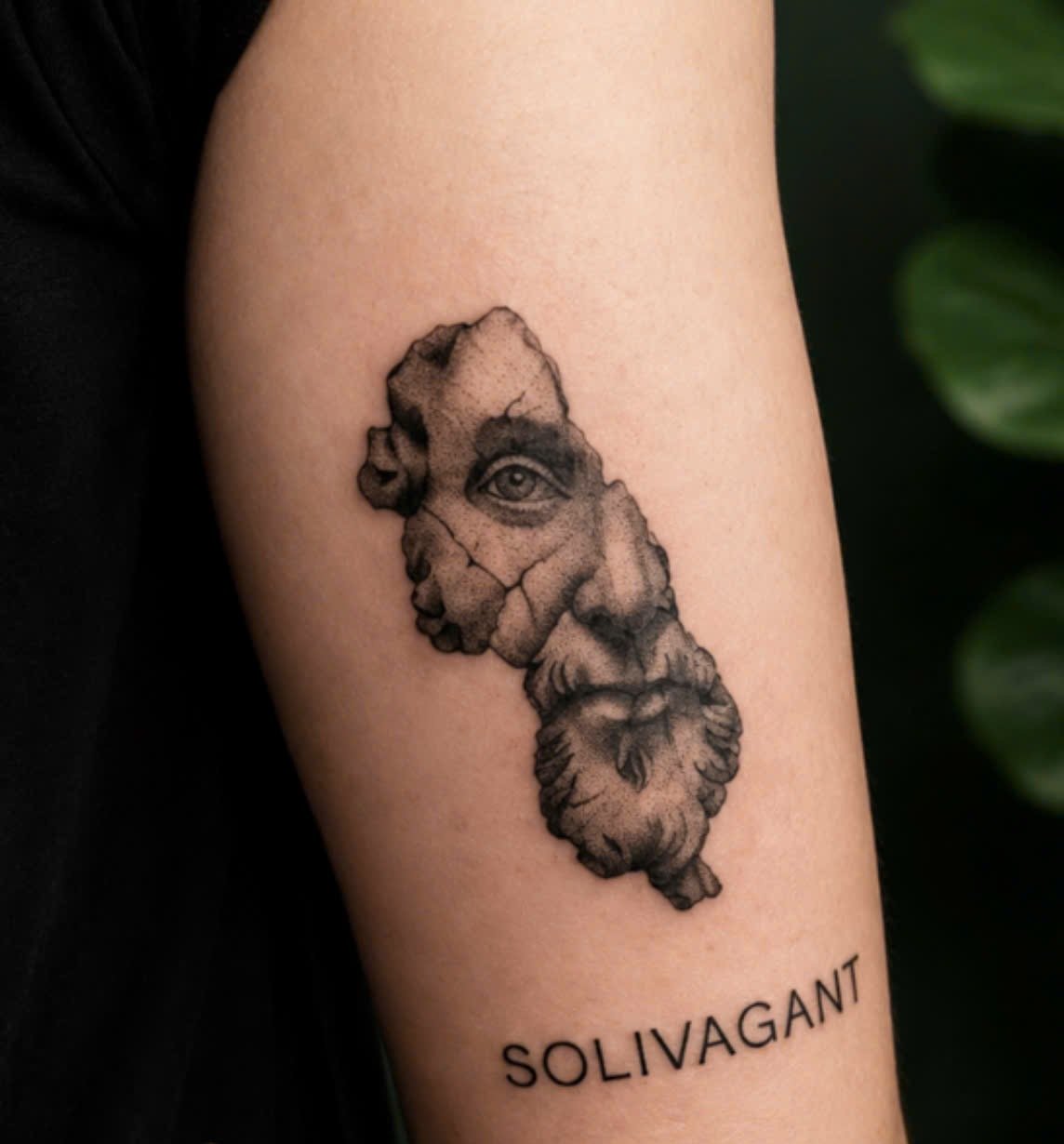
Our gallery includes a fine-line cracked stone bust on the forearm, in the same classical-marble tradition Aphrodite and Venus are most often carved in, and a helmeted goddess portrait on the upper arm for anyone leaning toward a full figure rather than a bust. At your consultation we can talk through which Aphrodite you actually mean — heavenly, common, Roman ancestor, or grieving lover — so the symbols we pair with her (shell, doves, myrtle, rose) say what you intend rather than a generic “goddess” outline. Our guide to Greek god tattoos covers how she fits alongside Zeus, Athena and the rest of Olympus, and if it’s really her son Eros/Cupid you’re picturing, our Cupid and cherub guide covers the arrows and the Psyche myth in full.
Related Guides
Ready to book your tattoo in Hanoi?
Send us your idea and preferred dates — we'll reply with a clear quote before you sit in the chair.
Book Now