 GOAT TATTOO
Rose Tattoo Meaning: Victorian Code vs. Ancient Secrecy
Published October 20, 2026
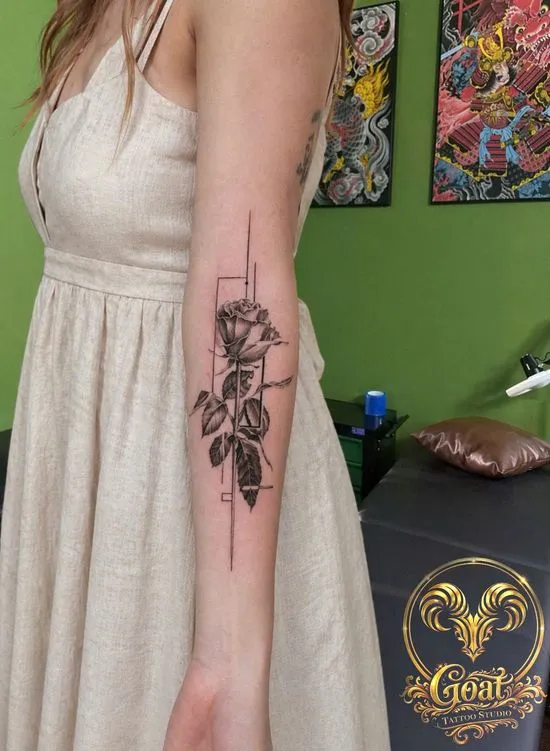
Short answer: most of the color rules people quote today — red for romantic love, yellow for friendship, black for farewell — don’t come from ancient myth at all. They were codified in 19th-century England and France, when published “language of flowers” dictionaries gave strangers a coded way to say what etiquette wouldn’t let them say outright. Separately, and much older, there’s a real Greco-Roman tradition behind the rose meaning secrecy — the English phrase “sub rosa” comes directly from it, and it’s rarely explained in full.
The rose is the single most requested flower tattoo we do, by a wide margin, and most people already have a rough sense it means “love.” That’s not wrong, but it skips the two traditions that actually explain where the specific rules — which color, thorns or no thorns, bud or full bloom — came from in the first place.
Victorian floriography: where the color rules actually came from
In 19th-century England and France, strict social etiquette meant you often couldn’t say “I love you,” express doubt, or decline a suitor directly — so an entire coded system called floriography, or the “language of flowers,” grew up around giving specific flowers to say it instead. Published dictionaries like Charlotte de la Tour’s Le Langage des Fleurs (1819) and Kate Greenaway’s Language of Flowers (1884) assigned fixed meanings by flower and color, and the rose was the system’s single most detailed entry. A red rose meant romantic, passionate love. A white rose meant purity or innocence. A yellow rose, oddly to modern ears, originally signaled jealousy or infidelity — a way of telling someone you suspected them, not a friendly gesture. That meaning has genuinely flipped since: today a yellow rose reads as friendship and joy, which is worth knowing if you’re drawing on the old code specifically rather than the modern one. A black rose isn’t a real botanical color at all — roses don’t grow true black, only a crimson so deep it reads as black — and symbolically it settled into meaning death, farewell, or the end of something, not anything sinister.
Sub rosa: the real reason a rose means secrecy
Separately from the Victorian color code, there’s a much older and more specific tradition behind the rose as a symbol of confidentiality — and it’s the real origin of a phrase still used in English and several other languages today. In Greek myth, Cupid (Eros) gave a rose to Harpocrates, the god of silence, to bribe him into staying quiet about Venus’s romantic affairs. The Romans picked up the association directly, and it became architectural: a rose carved or painted onto the ceiling of a council chamber, confessional, or private dining room was a literal, understood signal that whatever was said beneath it stayed in that room. That’s the actual origin of “sub rosa” — Latin for “under the rose” — which English still uses today to mean something said off the record or in strict confidence. It’s a genuinely documented etymology, not the vague “roses are mysterious” reading a lot of generic tattoo-meaning pages default to.
Thorns, buds, and stems: what the physical details add
Beyond color and the two traditions above, the rose’s physical form carries its own layer of meaning that’s independent of both. Thorns on the stem commonly represent the idea that beauty and difficulty coexist — that something worth having isn’t necessarily easy to hold. A closed bud leans toward potential or a love that’s new and still unfolding, while a full, open bloom reads as completion or maturity. A broken stem or a wilting rose is a more specific, deliberate choice, generally used to mark loss or something cut short rather than a generic sad flower — worth being clear with your artist about which of these you actually mean, since they read very differently side by side.
What actually matters when choosing
If the Victorian color code is what you’re after, be specific about which color and era-accurate meaning you want, since a couple of those readings (yellow especially) have genuinely reversed over time. If it’s the secrecy tradition that drew you in, the sub rosa history is real and well documented, and worth mentioning at your consultation so the design can lean into that rather than the generic romantic reading. And if you simply love how roses look, that’s a complete reason on its own — plenty of people choose one with no interest in either tradition, and that’s entirely legitimate too.
What to expect at GOAT Tattoo Studio
We’re happy to talk through which reading you’re actually going for at your consultation, and how thorns, bud state, or color should shape the final design — our guide to flower tattoo meanings covers other commonly requested florals worth understanding beyond how they look.
Related Guides
- Flower Tattoo Meanings Explained
- Chrysanthemum Tattoo Meaning: Imperial Honor vs. Funeral Flower
- Lotus Tattoo Meaning: Buddhist Symbol vs. Vietnam's National Flower
- Popular Small Tattoo Symbols and What They Actually Mean
- Peony Tattoo Meaning: King of Flowers in China, Japan and Vietnam
- Poppy Tattoo Meaning: Remembrance, Sleep, Dreams and Peace
- Lily Tattoo Meaning: Purity, Rebirth and What Each Colour Means
- Aphrodite Tattoo Meaning: Two Goddesses, Not One
Ready to book your tattoo in Hanoi?
Send us your idea and preferred dates — we'll reply with a clear quote before you sit in the chair.
Book Now