 GOAT TATTOO
Spartan Tattoo Meaning: Molon Labe, Thermopylae and the Helmet
Published October 22, 2026
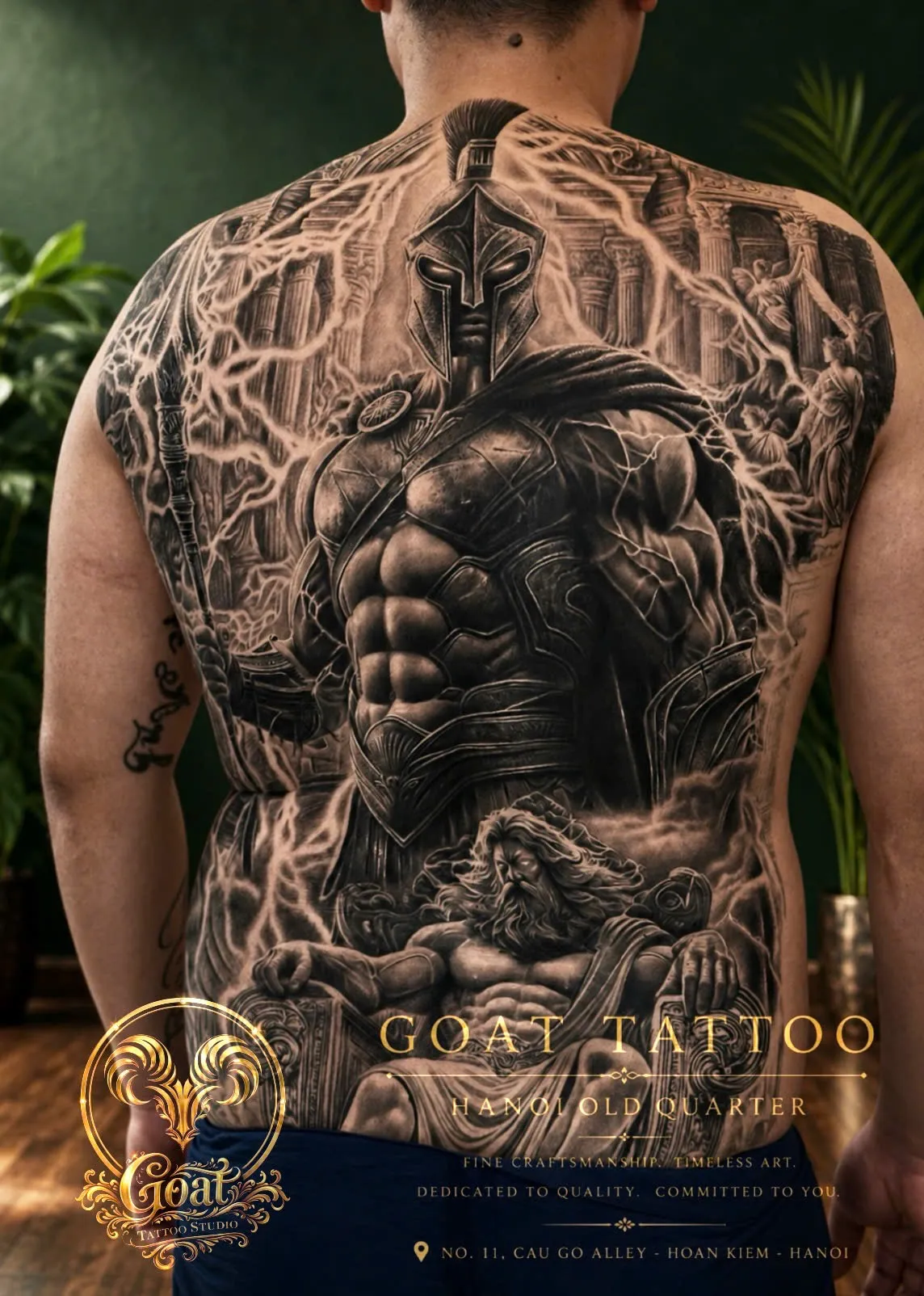
Short answer: a Spartan tattoo stands for courage, discipline, loyalty and refusing to give up. Most Spartan tattoos point back to the Battle of Thermopylae in 480 BC, where King Leonidas and his small force held a narrow pass against the huge Persian army. The helmet alone usually means inner strength and self-control, while phrases like “Molon labe” (“come and take them”) add a message of defiance. Many people choose it after military service, years of hard training, or a personal fight they did not give up on.
The Spartan warrior is one of the most popular “strength” tattoos in the world, and it works especially well in black and grey realism. Here is where the symbols come from, what they mean, and what to think about before you get one.
Who the Spartans were
Sparta was a city-state in southern Greece, famous for its army. From childhood, Spartan boys went through a hard state training system called the agoge, and adult men were full-time soldiers. Ancient writers admired them for discipline, short and sharp speech (the word “laconic” comes from Laconia, their region) and for standing their ground in battle.
There is a darker side too. Spartan life depended on the helots, a large population of enslaved people who farmed the land. A Spartan tattoo is almost always about the warrior ideal rather than the real society, but it’s worth knowing the history is more complicated than the films.
Thermopylae and the 300
In 480 BC the Persian king Xerxes invaded Greece. At the pass of Thermopylae, King Leonidas of Sparta led about 300 Spartans, together with several thousand other Greek soldiers, to block the Persian advance. They held for days until they were betrayed and surrounded, and Leonidas and his men fought to the end. The stand became a symbol of a few people holding firm against overwhelming odds.
The film 300 (2006) made this story famous again, and its look (bare chests, red cloaks, crested helmets) shaped many modern Spartan tattoos.
The symbols and phrases
- The helmet: the bronze Corinthian helmet with a crest is the most recognisable Spartan image. On its own it usually means strength, protection and a warrior mindset.
- The lambda shield: Spartan shields are traditionally said to carry the Greek letter Λ (lambda), for Lacedaemon, the official name of their state.
- Molon labe (ΜΟΛΩΝ ΛΑΒΕ): “come and take them”. According to the Greek writer Plutarch, this was Leonidas’s reply when Xerxes ordered the Greeks to hand over their weapons.
- “With your shield or on it”: Plutarch also records Spartan mothers telling their sons to come home with their shield (victorious) or carried on it (dead), never having thrown it away to run.
- Spear and red cloak: complete the warrior figure and add colour or movement to a black and grey piece.
If you add Greek lettering, check the spelling with someone who reads Greek before it becomes permanent. Our guide to checking lettering explains how.
What people mean by it today
- Military and police service, often with a unit number or date.
- Sport and training: fighters, lifters and obstacle racers use the Spartan as a symbol of discipline.
- Getting through something hard: illness, addiction recovery or a difficult chapter, where the battle is personal.
- Protection of family: the warrior who stands in front of the people he loves.
“Molon labe” is also used as a slogan by some political and gun-rights groups, especially in the United States. Most people will read your tattoo as Greek history, but on a visible placement it’s worth knowing the phrase can carry that meaning for some viewers.
Popular combinations
Spartan tattoos are often part of a larger Greek mythology piece. Common pairings are a lion for courage, lightning and Zeus for power, and a shield with Medusa’s face, the ancient protective image. For the gods themselves, see our Greek god tattoo guide.
Design and placement
- Full back or chest: the best space for a full warrior scene with a background of columns, lightning or a battlefield.
- Sleeve or thigh: a warrior portrait with a helmet and spear fits the length of the limb.
- Forearm or calf: a helmet alone, or a helmet with a short phrase.
- Small sizes: keep it simple. A helmet outline or a lambda reads well small; a detailed face does not.
Black and grey realism suits the metal of the helmet and the marble look of Greek statues. Detailed faces need enough size to stay clear as the tattoo ages.
At GOAT Tattoo Studio
Our gallery includes several Spartan back pieces in black and grey: a helmeted Spartan warrior in front of a lightning-lit statue of Zeus, an armoured Spartan holding a shield with Medusa’s face amid lightning, a Spartan warrior within a larger Greek mythology scene, and a gladiator paired with a lion. At your consultation we can help you plan the composition, size and how many sessions it will take. For full back pieces, our cost guide for sleeves and back pieces explains pricing.
Planning a realistic piece in Hanoi? Our realistic and portrait tattoo page shows prices, the artists who do this style and recent work.
Related Guides
- Greek God Tattoo Meaning: Zeus, Poseidon, Athena, Hades and Apollo
- Medusa Tattoo Meaning: Protection, Power and Survival
- Samurai Tattoo Meaning: Bushido, Ronin and Cherry Blossoms
- Lion Tattoo Meaning: Guardian vs. King
- Black & Grey Realism Tattoos: What to Actually Look For
- How Much Does a Full Sleeve or Back Piece Really Cost?
- Anubis Tattoo Meaning: Guardian of the Dead, Not a God of Evil
- Eagle Tattoo Meaning: Rome to Aztec
- Greek Statue Tattoo Meaning: Broken Busts, Stoics and Lost Colours
Ready to book your tattoo in Hanoi?
Send us your idea and preferred dates — we'll reply with a clear quote before you sit in the chair.
Book Now