 GOAT TATTOO
Greek Statue Tattoo Meaning: Broken Busts, Stoics and Lost Colours
Published October 27, 2026
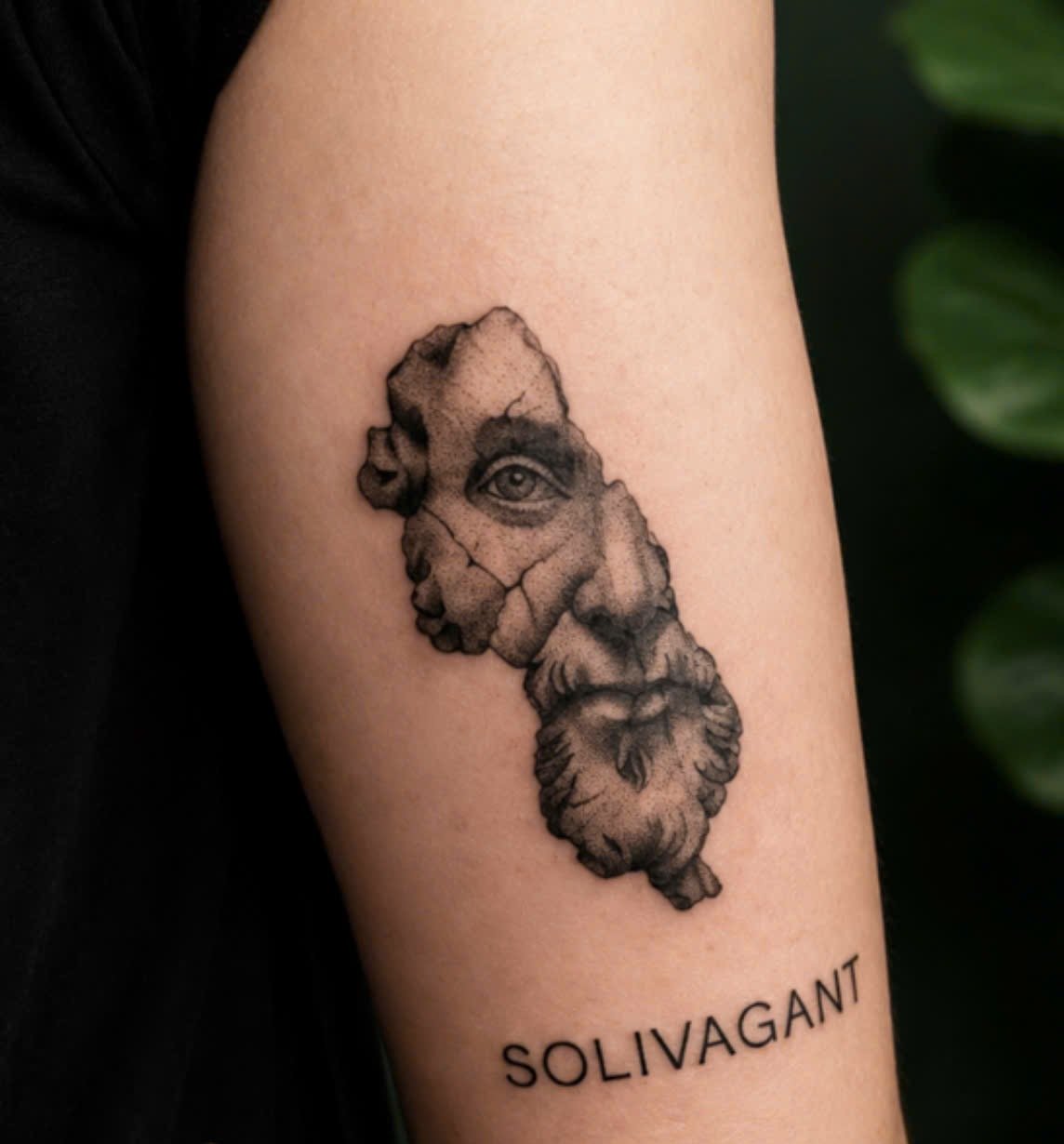
Short answer: a Greek or Roman statue tattoo usually stands for strength, balance and timeless beauty, the ideals of classical art. A broken or cracked statue adds another layer: it means that nothing lasts forever, that damage and imperfection can be beautiful, and that what remains of a person after hard times is still worth looking at. Bearded busts are often read as philosophers, and the Stoic emperor Marcus Aurelius is a popular choice for people who live by Stoic ideas of calm and self-control. Many people also add a word or quote, which turns the statue into a personal motto.
Marble statues are among the most popular subjects for black-and-grey tattoos, because skin and shading can copy the smooth surface of stone so well. Here is what these statues meant to the people who made them, what a broken one can mean on your skin, and how to design a piece that ages well.
The classical ideal: strength and balance
Greek sculptors of the 5th and 4th centuries BC tried to show the perfect human body: strong, calm and in balance. Famous works such as the Discobolus (discus thrower) and the Doryphoros (spear bearer) were studied for their proportions for centuries. Many of the statues we know today are actually Roman marble copies of Greek bronze originals that were later melted down. As a tattoo, a whole statue can stand for discipline, physical strength, self-respect, or a love of art and history. Statues of gods carry the meaning of the god they show; see our Greek gods guide and Medusa guide for those stories.
Broken statues: time, loss and imperfection
Almost every ancient statue has been damaged: noses broken, arms lost, heads separated from bodies. Some of the most famous are famous partly because of what is missing. The Venus de Milo has no arms, the Winged Victory of Samothrace has no head, and the Belvedere Torso, admired by Michelangelo, is only a seated body. The English poet Percy Shelley wrote “Ozymandias” (1818) about a traveller who finds the broken face of a great king’s statue in the empty desert, a reminder that even the most powerful people are forgotten. So a cracked or crumbling bust can mean:
- Impermanence: everything changes, so live well now.
- Beauty in imperfection: being broken does not make something less valuable, an idea also found in Japanese kintsugi.
- Survival: you have been damaged by life and are still standing.
- Hidden self: a face that breaks open to show something else inside, such as flowers, light, a skull or another face.
Philosophers and the Stoics
A bearded bust is often read as a philosopher, because Greek and Roman portraits of thinkers usually showed them with full beards. Today one of the most requested is Marcus Aurelius, the Roman emperor whose private notes, known as the Meditations, are still read as a guide to Stoic philosophy: control what you can, accept what you cannot, and stay calm and fair. Seneca and Epictetus, two other Stoic writers, are also popular. A Stoic bust tattoo is often paired with a short Latin phrase such as memento mori (“remember that you will die”) or amor fati (“love your fate”). If you add text, check the spelling and grammar carefully; our lettering guide explains how to choose a font that stays readable.
The lost colours
Classical statues were not originally white. Traces of paint found on many pieces show that they once had coloured skin, eyes, lips, hair and clothing, and some had glass or stone eyes and metal details. Over the centuries the paint wore off, and when Renaissance and later artists rediscovered ancient sculpture, they believed pure white marble was the classical ideal. That is a nice meaning for a statue tattoo too: what we see now is only part of the original story. A black-and-grey statue keeps the look we know from museums, while a statue with a few touches of colour, such as gold leaves or blue eyes, can be a quiet nod to how it really looked.
Words and personal meaning
Statue tattoos often include a single word underneath. Our own piece below uses solivagant, a rare English word from the Latin solivagus, meaning “wandering alone”, which many solo travellers choose. A statue with a word like this becomes a portrait of an attitude rather than a person: the calm, slightly weathered face of someone who has travelled far on their own. If you are travelling alone yourself, our solo traveller guide explains how to plan a tattoo on the road.
Design and placement
- Style: black-and-grey realism gives the smoothest stone. Dotwork and stippling gives a rougher, grainy surface that suits old, weathered stone very well. Fine-line outlines work for small, simple busts.
- Cracks and breaks: decide how broken the statue should be. A few thin cracks look elegant; large missing pieces need clear edges so the shape still reads from a distance.
- Combinations: statue with flowers growing from the cracks, with a laurel wreath, a Spartan helmet, columns, a sunset, a skull, butterflies or a quote.
- Size: faces need room for the eyes and expression to stay clear. A palm-sized bust is a good minimum for a detailed face.
- Placement: forearm, upper arm, calf, thigh, shoulder or chest. A tall bust with a word below fits the inner forearm very well; see our forearm tattoo price guide for sizes and costs.
At GOAT Tattoo Studio
Our gallery includes a black-and-grey dotwork forearm tattoo of a cracked stone bust: a bearded face broken into an irregular fragment, with one realistic eye, the nose, mouth and curling beard shaded in fine dots and thin cracks running across the stone. The word “SOLIVAGANT” is written below in a clean, simple font. In a consultation we can help you choose the statue, how broken it should be, the shading style and any words to go with it.
Planning a realistic black-and-grey statue or portrait in Hanoi? Our realism and portrait tattoo page shows prices, the artists who work in this style and recent work.
Related Guides
- Greek God Tattoo Meaning: Zeus, Poseidon, Athena, Hades and Apollo
- Medusa Tattoo Meaning: Protection, Power and Survival
- Spartan Tattoo Meaning: Molon Labe, Thermopylae and the Helmet
- Kintsugi Tattoo Meaning: Golden Repair, Scars and Wabi-Sabi
- Black & Grey Realism Tattoos: What to Actually Look For
- Dotwork & Stippling Tattoos: What to Actually Look For
- Getting a Tattoo as a Solo Traveler in Hanoi
- Forearm Tattoo Price & Pain Guide — Hanoi
Ready to book your tattoo in Hanoi?
Send us your idea and preferred dates — we'll reply with a clear quote before you sit in the chair.
Book Now