 GOAT TATTOO
Cloud Tattoo Meaning: Auspicious Clouds, Dragons and Heaven
Published October 27, 2026
Short answer: in East Asian art a cloud tattoo usually means good fortune, blessings and a link to heaven. Chinese “auspicious clouds” (xiangyun) are drawn as curling, stylised scrolls and appear on palaces, temples and robes as a sign of luck, partly because the word for cloud sounds close to the word for fortune. Clouds carry gods, immortals and dragons, and the Monkey King rides one across the sky. In Japanese irezumi clouds fill the background around dragons and gods, and in Vietnam “dragon and clouds” (rồng mây) is an old image of success. In Western tattoos a soft cloud more often stands for dreams, peace or a loved one in heaven, while a storm cloud stands for hard times.
Clouds are often treated as filler in large tattoos, but a well-drawn cloud can be a strong design on its own, especially the ornamental Asian style. Here is what clouds have meant in different traditions and how to design one that reads clearly on the skin.
China: auspicious clouds and the ruyi
In Chinese art the classic cloud is the xiangyun (祥云), the auspicious cloud: a spiral head with a flowing tail, often stacked in layers. It decorates imperial buildings, ceramics, embroidery and jewellery, and it was the main pattern on the torch of the 2008 Beijing Olympics. Part of the appeal is wordplay: yún (云, cloud) sounds close to yùn (运, luck or fortune), so clouds suggest good fortune rising. A closely related shape is the ruyi (如意), a curved head that looks like both a cloud and a lingzhi mushroom, whose name means “as you wish”. Ruyi-shaped clouds are a blessing that your wishes come true.
Clouds that carry gods and heroes
In Chinese myth, clouds are how heavenly beings travel. Immortals and gods arrive standing on clouds, cranes fly among them, and dragons are almost always drawn half-hidden in them, because the dragon brings rain and lives in the sky. The most famous cloud rider is Sun Wukong, the Monkey King of Journey to the West, whose somersault cloud can carry him 108,000 li in a single leap. A cloud under a figure or animal therefore says that it belongs to heaven, and a cloud on its own can mean freedom and the ability to rise above things. Our monkey guide tells more of Sun Wukong’s story.
Clouds in Japanese irezumi
In traditional Japanese tattooing, a large piece is built from a main subject and a background, and the background is usually made of water, wind bars and clouds. Clouds (kumo) tell you the scene is set in the sky or the heavens, so they surround dragons, phoenixes, Buddhist figures and the thunder and wind gods Raijin and Fujin, while waves tell you the scene is in the water. Japanese clouds are drawn with bold black outlines and smooth curls, often in grey shading so that the bright main subject stands out. Our Japanese motifs guide explains how these elements fit together.
Vietnam: dragon and clouds
Cloud patterns (họa tiết mây) are everywhere in traditional Vietnamese art: on pagoda and temple roofs, on the royal buildings and robes of Huế, on bronze and ceramics, and around nearly every dragon. Vietnamese has the saying rồng mây gặp hội, “the dragon meets the clouds”, for a lucky moment when a talented person finally finds their chance to succeed. So a dragon in clouds, or a cloud motif on its own, can stand for good timing, ambition and success. Our history of Vietnamese tattooing covers more of the country’s traditional imagery.
Western clouds: dreams, heaven and storms
In Western tattooing clouds are usually softer and more realistic, and their meaning depends on the weather:
- Soft white clouds: dreams, calm, freedom and a light mind (“head in the clouds”).
- Clouds with light rays or angel wings: heaven, and often a memorial for someone who has died.
- Storm clouds and lightning: anger, struggle or a hard period, sometimes paired with a boat or a tree that survives it.
- A cloud with rain or a rainbow: sadness that passes, or hope after a difficult time (“every cloud has a silver lining”).
Design and placement
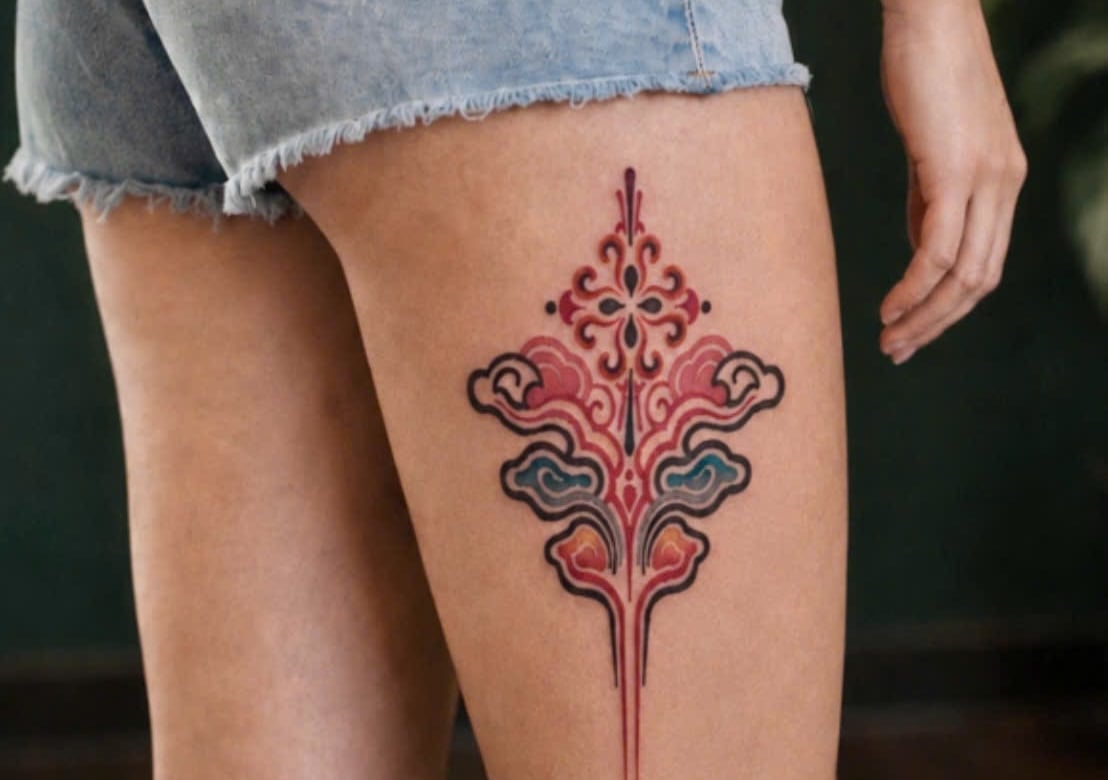
- Style: ornamental Asian clouds look best with bold, clean outlines and solid color or smooth shading, like our piece below. Realistic Western clouds are usually black and grey with soft gradients.
- Composition: ornamental clouds work well in a symmetrical design, stacked in pairs along a central line. In a larger piece they connect other elements, such as a dragon, a koi or a figure, and fill the gaps between them.
- Color: red, pink and gold suggest luck and celebration, blue and teal suggest sky and calm. Shaded grey clouds keep a large piece from looking too busy.
- Size: the curls of an ornamental cloud need room to stay open as the tattoo ages. A single cloud of about palm size is a good minimum; tiny clouds work better as simple line outlines.
- Placement: a tall, symmetrical cloud design suits the back of the thigh, the spine, the forearm or the calf. See our thigh tattoo price guide for sizes and costs.
At GOAT Tattoo Studio
Our gallery includes a color ornamental cloud tattoo on the back of the thigh: a symmetrical, vertical design with a red filigree diamond at the top and pairs of curling clouds below it in pink, teal and orange, each with a bold black outline, all held together by a red central stem that narrows into fine lines at the bottom. In a consultation we can help you choose between ornamental, Japanese and realistic clouds, decide on colors, and build clouds around a dragon or another main subject.
Interested in Asian motifs with a Vietnamese story behind them? Our traditional Vietnamese tattoo page shows the symbols we draw, prices and recent work.
Related Guides
- Dragon Tattoo Meaning: East vs. West
- Japanese Wave Tattoo Meaning: Hokusai's Great Wave and Irezumi Water
- Raijin and Fujin Tattoo Meaning: Japan's Thunder and Wind Gods
- Japanese Tattoo Motifs and What They Actually Mean
- Monkey Tattoo Meaning: Sun Wukong & Hanuman
- Phoenix Tattoo Meaning Explained
- The Real History of Tattooing in Vietnam
- Thigh Tattoo Price & Pain Guide — Hanoi
Ready to book your tattoo in Hanoi?
Send us your idea and preferred dates — we'll reply with a clear quote before you sit in the chair.
Book Now