 GOAT TATTOO
Bonsai Tattoo Meaning: Patience, Balance and Resilience
Published October 25, 2026
Short answer: a bonsai tattoo usually means patience, balance and quiet strength. A bonsai is a real tree kept small through years of careful pruning and shaping, so it stands for slow, steady growth, self-discipline and the care you put into something over a lifetime. Because bonsai can survive for centuries and are passed down through families, the tattoo can also mean resilience and family roots. Its origins are Chinese (penjing), it was refined in Japan, and Vietnam has its own related art, hòn non bộ.
A bonsai has a strong, recognisable outline: a twisting trunk, a few clouds of leaves and roots gripping the ground. Here is what it means and how to design one that stays clear.
Where bonsai comes from
The art began in China as penjing, “tray scenery”, more than a thousand years ago: small trees and rocks arranged in a shallow pot to show a whole landscape in miniature. It travelled to Japan, where it became bonsai, written with the same characters 盆栽, “planted in a tray”, and was shaped by Zen Buddhist ideas of simplicity and calm.
Vietnam has its own tradition too. Hòn non bộ are miniature mountain landscapes with rocks, water and small trees, and shaped ornamental trees (cây cảnh) are kept in courtyards and temples, especially around Tết. A bonsai tattoo can honour any of these three cultures.
Patience and slow growth
A bonsai cannot be rushed. It takes years of watering, pruning and wiring to shape one tree, and the work is never really finished. That is why the bonsai is such a popular symbol for people who are building something slowly: a career, a recovery, sobriety, a family, or simply a calmer life. It is a reminder that small daily care adds up.
Balance and harmony
A good bonsai is balanced but not symmetrical. The trunk leans, the branches are uneven, and yet the whole tree feels calm. This connects to the Japanese idea of wabi-sabi, finding beauty in imperfection, which is also behind kintsugi. As a tattoo, a bonsai can mean accepting your own uneven shape and still standing steady. Adding a sun and moon above the tree makes the idea of balance even stronger.
Resilience: the Hiroshima bonsai
One of the most famous bonsai in the world is a Japanese white pine that has been in training since about 1625. In 1945 it sat in the Yamaki family’s nursery in Hiroshima, a few kilometres from where the atomic bomb fell. The wall around it protected it, and it survived. In 1976 the family gave it to the United States, and it still grows today at the National Bonsai and Penjing Museum in Washington, D.C.
That story makes the bonsai a powerful symbol of survival and peace: something small and carefully tended that outlasts disaster.
Family and roots
Bonsai are often passed from parents to children, and some trees have been cared for by several generations. A bonsai tattoo can honour a grandparent who kept trees, or show your family as one shared trunk with many branches. Visible roots add the meaning of staying grounded. Our tree of life guide and family symbols guide have more ideas.
Bonsai styles and what they say
- Formal upright: a straight trunk. Stability and confidence.
- Informal upright or S-curve: a trunk that bends but rises. Growth through difficulty.
- Cascade: the tree falls over the edge of the pot, like a tree on a cliff. Survival against the odds.
- Windswept: all branches pushed to one side. Holding on through storms.
- Blossoming: a flowering bonsai, often cherry or plum. See our cherry blossom guide.
Design and placement
- Style: black and grey realism gives the bark and leaves depth. Ink-wash Japanese styles give a painted, brushstroke feel. Geometric circles and lines around the tree add a modern, balanced frame.
- Pot or no pot: a pot makes it clearly a bonsai; leaving it out and showing roots makes it feel wilder and more personal.
- Placement: forearm, upper arm, calf, spine or shoulder blade. A vertical tree suits long, narrow areas.
- Size: leave space between the leaf clusters so they do not merge into one dark shape over the years.
At GOAT Tattoo Studio
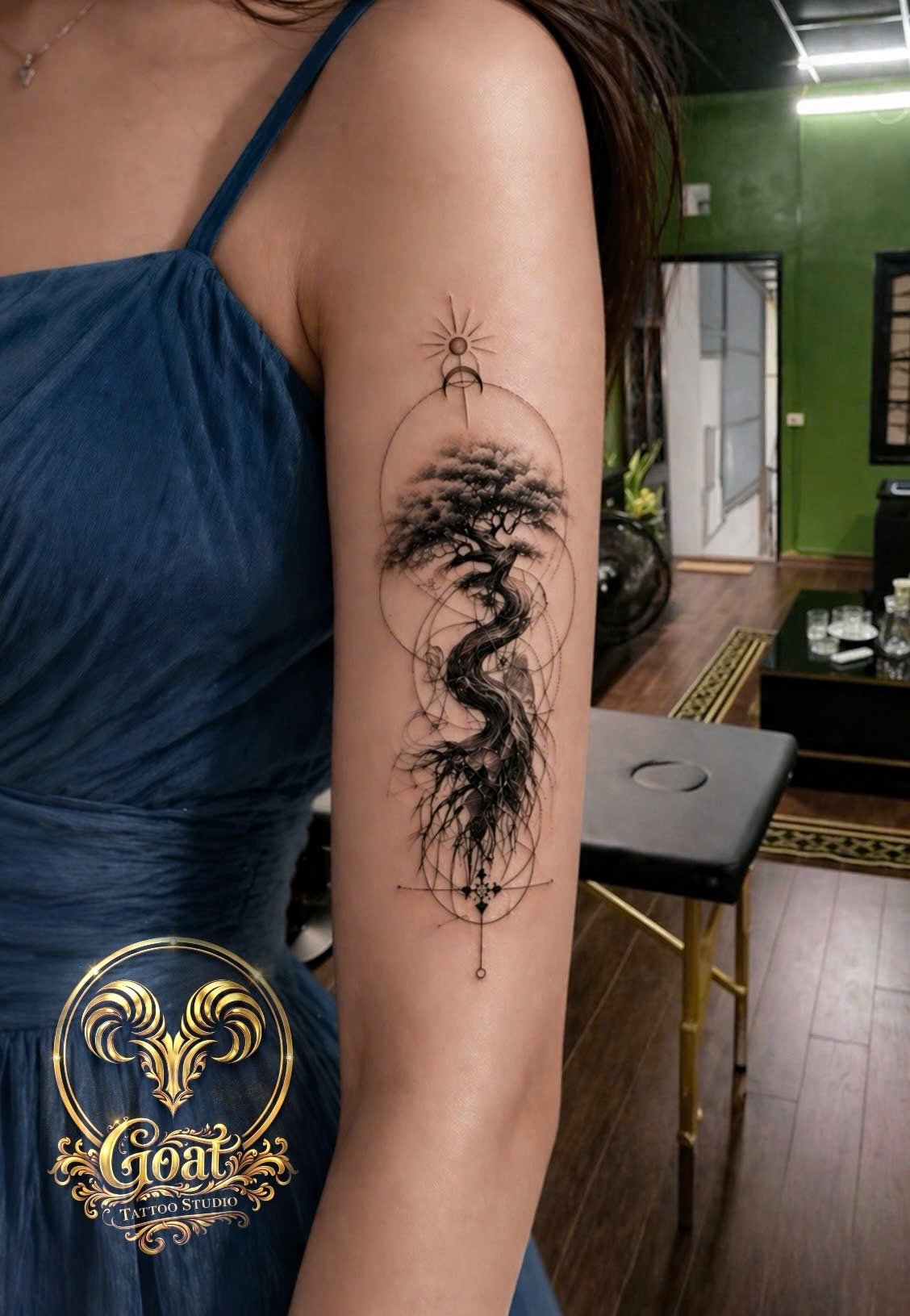
In our gallery there is a black and grey bonsai on the upper arm: a tree with soft, misty leaves and an S-shaped trunk, roots spreading below, set inside thin sacred-geometry circles, with a small sun and crescent moon on top. In a consultation we can help you choose the tree style, the frame and the size.
Interested in geometric framing for a nature design? Our mandala and geometric tattoo page shows prices, the artists for this style and recent work.
Related Guides
- Tree of Life Tattoo Meaning Explained
- Japanese Tattoo Motifs and What They Actually Mean
- Kintsugi Tattoo Meaning: Golden Repair, Scars and Wabi-Sabi
- Sun and Moon Tattoo Meaning: Helios & Selene
- Mandala & Geometric Tattoos: What to Actually Look For
- Black & Grey Realism Tattoos: What to Actually Look For
- Cherry Blossom Tattoo Meaning: Sakura, Plum or Peach Blossom?
- Family Tattoo Symbols: Meanings and Ideas That Last
Ready to book your tattoo in Hanoi?
Send us your idea and preferred dates — we'll reply with a clear quote before you sit in the chair.
Book Now