 GOAT TATTOO
Palm Tree Tattoo Meaning: Paradise, Resilience and Victory
Published October 26, 2026
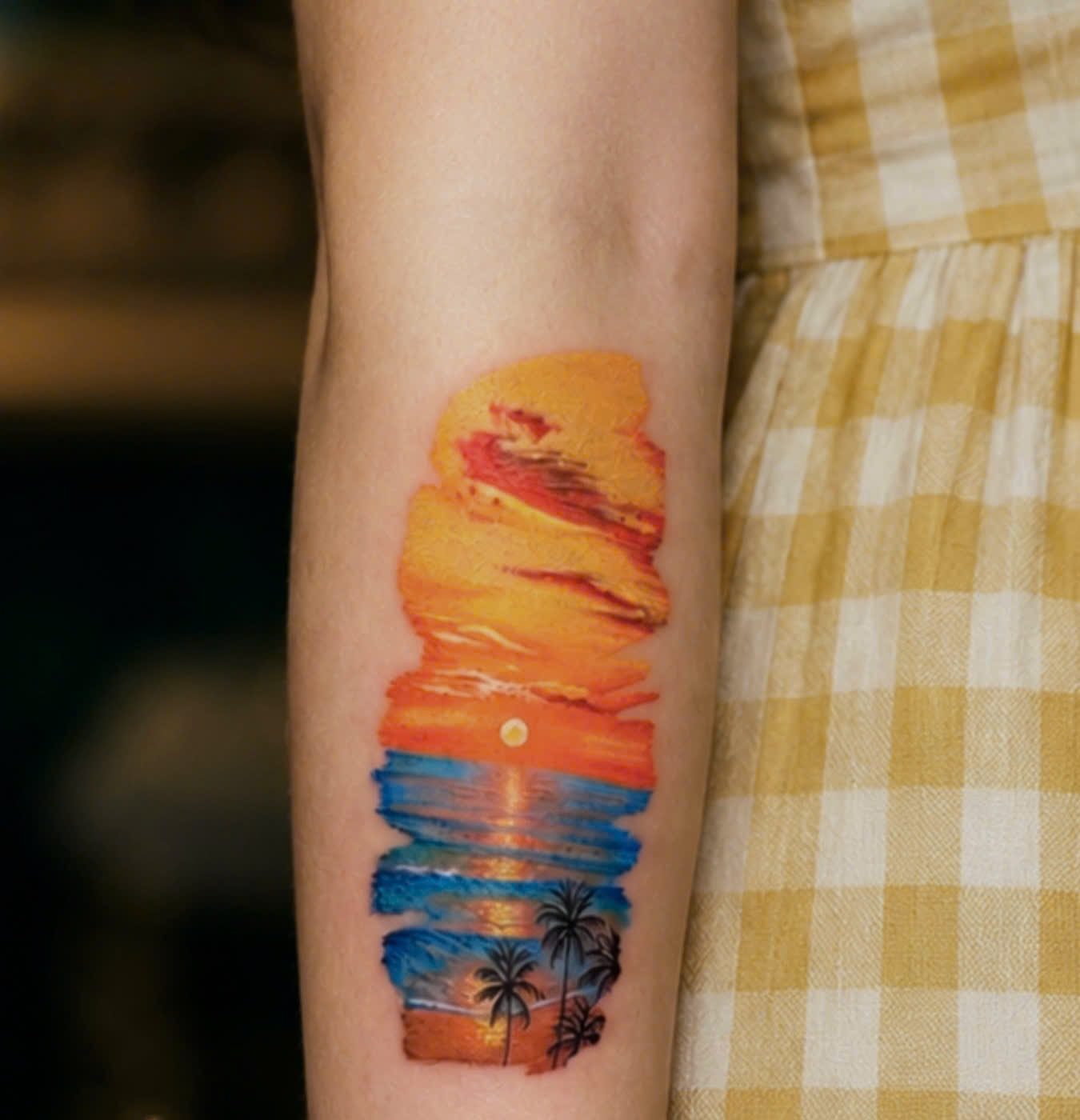
Short answer: a palm tree tattoo usually means paradise, freedom and a relaxed, sunny state of mind, and many people get one to remember a beach trip, a honeymoon or a home by the sea. It is also a symbol of resilience, because palms bend in tropical storms instead of snapping. In the ancient Mediterranean a palm branch meant victory: winners of the Greek games received one, and Christians later used it for Palm Sunday and for martyrs. In Egypt the palm rib was the sign for “year”, and across the tropics the coconut palm is called a “tree of life” because every part of it is useful.
A palm tree is one of the simplest silhouettes you can tattoo, but it carries more history than most people expect. Here is where its meanings come from and how to design one that still looks good years after the holiday.
Paradise, freedom and holidays
For most people today, a palm tree means the beach: warm sand, slow days and no alarm clock. That is why it is such a popular travel tattoo, chosen to remember a first trip abroad, a year spent living near the sea or a honeymoon on an island. It can also be a promise to yourself to slow down, or a reminder of a place where you felt free. Two small palms are a common matching tattoo for couples who met or married somewhere tropical.
Resilience: bending, not breaking
Palm trunks are flexible. In a hurricane or typhoon a palm can bend almost to the ground and then stand up again when the wind has passed, while stiffer trees nearby are broken or pulled out by the roots. Its roots are also spread wide and shallow, holding on to loose sand. So a palm tree can mean getting through a hard time without losing yourself, staying calm under pressure, or putting down roots somewhere new. Many people pair it with a wave to show the storm it survived.
Victory: Egypt, Greece and Rome
The date palm was one of the most important trees of the ancient Middle East and North Africa, giving food, shade and building material in the desert. In Egyptian hieroglyphs a notched palm rib was the sign for “year”, because a new notch could be counted for each season, so the palm was linked with time and long life. In ancient Greece, winners at games such as the Olympics were given a palm branch, and the goddess of victory, Nike, was often shown holding one. The Romans carried palm branches in their triumphal parades, and the idea survives in English: to “bear the palm” still means to win.
Faith: Palm Sunday, Sukkot and Maryam
In Christianity, crowds waved palm branches as Jesus entered Jerusalem, which is remembered every year on Palm Sunday, the start of Holy Week. Early Christian art also showed martyrs holding a palm frond as a sign of victory over death. In Judaism, a closed date-palm frond called the lulav is one of the four plants held during the festival of Sukkot. In the Qur’an, Maryam (Mary) gives birth to Jesus beside a palm tree and is told to shake its trunk so that fresh dates fall to her, and dates are still the traditional food for breaking the fast in Ramadan. For people of faith, a palm can quietly stand for peace, blessing and hope. See our religious and spiritual symbols guide for more.
The coconut palm: a tree of life
In Southeast Asia and the Pacific islands the coconut palm is often called the tree of life, because nothing is wasted: the water and flesh are food and drink, the oil is used for cooking and skin, the fibre becomes rope and mats, the leaves make roofs and baskets, and the trunk is used for building. In Vietnam, the Mekong Delta province of Bến Tre is famous as the land of coconuts. A coconut palm tattoo can mean being generous, being useful to the people around you, or simply loving the tropics. If you like the idea of a tree as a symbol of life and family, see also our tree of life guide.
Design and placement
- Style: palms work very well as black silhouettes against a colour sunset, in watercolour or painted styles, or as a minimal fine-line outline. Black-and-grey realism suits a whole beach scene with waves and clouds.
- Combinations: palm and sun or moon, palm and wave, palm inside a circle or a brushstroke shape, palm with coordinates or a date, palm with a small plane or a compass.
- Colour care: yellow, orange and light blue are among the first colours to fade in strong sun. If you are getting a sunset tattoo on holiday, keep it out of the sun while it heals and use sunscreen after, as explained in our sun exposure guide. A dark outline or dark silhouettes help the shape stay clear for years.
- Placement: forearm, ankle, behind the ear, ribs, calf or shoulder blade. Tall scenes fit the inner forearm well; see our forearm tattoo price guide for sizes and costs.
At GOAT Tattoo Studio
Our gallery includes a colour sunset beach on an inner forearm, painted in a tall brushstroke shape: a yellow and orange sky with streaks of red cloud, a small pale sun on the horizon, a blue sea with an orange path of light on the water, and black palm tree silhouettes on the sand at the bottom. In a consultation we can help you choose the colours, the shape of the frame and the placement, and turn a photo from your own trip into a design.
Planning a bright, painted design in Hanoi? Our colour and watercolour tattoo page shows prices, the artists who work in this style and recent work.
Related Guides
- Sun and Moon Tattoo Meaning: Helios & Selene
- Japanese Wave Tattoo Meaning: Hokusai's Great Wave and Irezumi Water
- Tree of Life Tattoo Meaning Explained
- Compass & Anchor Tattoo Meaning: Why They're Paired
- Watercolor & Illustrative Tattoos: What to Actually Look For
- Sun Exposure on a Fresh Tattoo: Protecting It for the Rest of Your Vietnam Trip
- Matching & Group Tattoos in Hanoi: A Booking Guide
- Forearm Tattoo Price & Pain Guide — Hanoi
Ready to book your tattoo in Hanoi?
Send us your idea and preferred dates — we'll reply with a clear quote before you sit in the chair.
Book Now