 GOAT TATTOO
Owl Tattoo Meaning: Wisdom vs. Omen
Published September 28, 2026
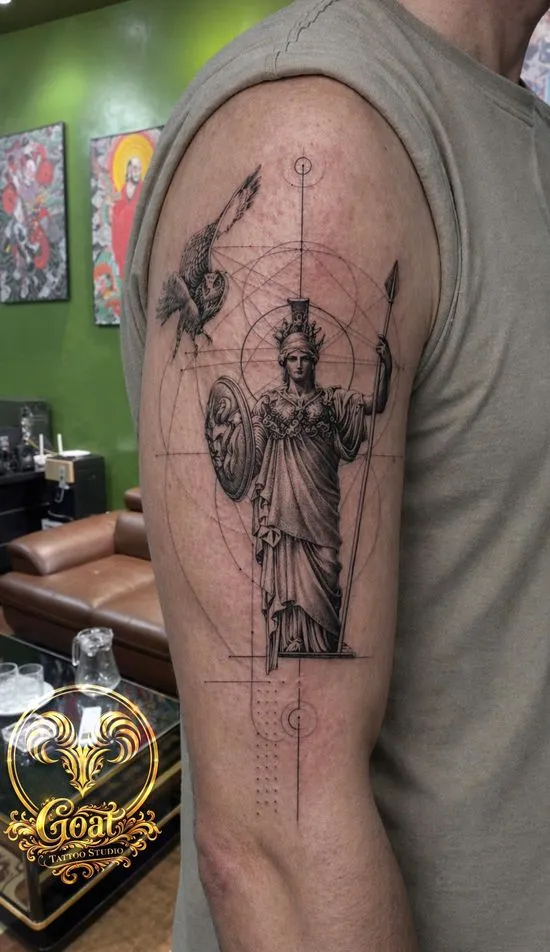
The owl is a genuinely popular tattoo subject, but it’s worth knowing upfront that its meaning isn’t one settled idea — it splits sharply depending on which tradition you’re drawing from, and the split isn’t even a simple “East vs. West” divide, since two Western traditions read the same bird in opposite ways.
Greek tradition: Athena’s owl, a symbol of wisdom and vigilance
In ancient Greece, the little owl (Athene noctua — its scientific name literally preserves the association) was sacred to Athena, goddess of wisdom and strategic warfare, and became a civic emblem of Athens itself. The bird appeared on the reverse of the city’s silver tetradrachm coins, popularly known as “owls,” alongside Athena’s profile on the obverse — a genuinely documented piece of ancient numismatic history, not a later invention. In this tradition, the owl represents wisdom, watchfulness, and protection specifically tied to the goddess and the city she guarded.
Roman tradition: the same bird, read as a warning of death
Roman writers inherited a great deal from Greek mythology, but not this particular reading — the naturalist Pliny the Elder, writing in his Natural History, describes the owl as a genuinely feared, funereal bird whose appearance in or near a city was treated as a portent of disaster, sometimes calling for ritual purification of the affected building or public space. This is worth sitting with honestly: it’s the same bird as Athena’s owl, inherited by a culture with close ties to Greek religion, yet read as close to the opposite thing. Symbolism doesn’t automatically carry over between neighboring traditions just because the animal does.
Japan: fukurou, a modern good-luck charm built on wordplay
Japanese tradition takes yet another direction, and a much more recent one — the owl (fukurou) is a widely sold good-luck charm, largely because the word invites a genuine pun: it can be parsed as fuku (“good fortune”) plus kurou (“hardship”) with a negating reading, giving “no hardship,” or alternatively as “fortune comes.” Owl figurines and charms are commonly sold at shrines, train stations, and gift shops, often given to travelers or students as a protective token against suffering. It’s a real, specific, and currently thriving tradition — but one built on language and modern folk custom rather than ancient myth, and it shares essentially nothing with either the Greek or Roman reading above.
What actually matters when choosing
If you want the wisdom-and-vigilance reading, an owl paired with visual cues tied to Athena — a helmet, an olive branch, a more austere or watchful pose — leans into the Greek tradition specifically. If protection and warding off hardship is the meaning you’re after, a rounder, friendlier-styled owl in the fukurou tradition communicates that more accurately than a fierce or shadowy design. The death-omen reading is real history too, and some people do deliberately choose it for a darker, memento-mori-style piece — but it’s worth knowing that’s the Roman association specifically, not a universal one, before you commit to it by accident through style alone.
What to expect at GOAT Tattoo Studio
We’re happy to talk through which owl tradition actually matches what you’re going for at your consultation — our guide to raven tattoo meaning covers a similar wisdom-versus-omen split for another nocturnal bird worth comparing before you decide.
Related Guides
Ready to book your tattoo in Hanoi?
Send us your idea and preferred dates — we'll reply with a clear quote before you sit in the chair.
Book Now